Beyond the Page: Why a Static Trading Journal PDF Cannot Protect Your Capital
Still printing out tracking sheets or using a hardbound book? Discover why static data tracking leaves your capital blind to market volatility and how to transition to a calculated risk framework.
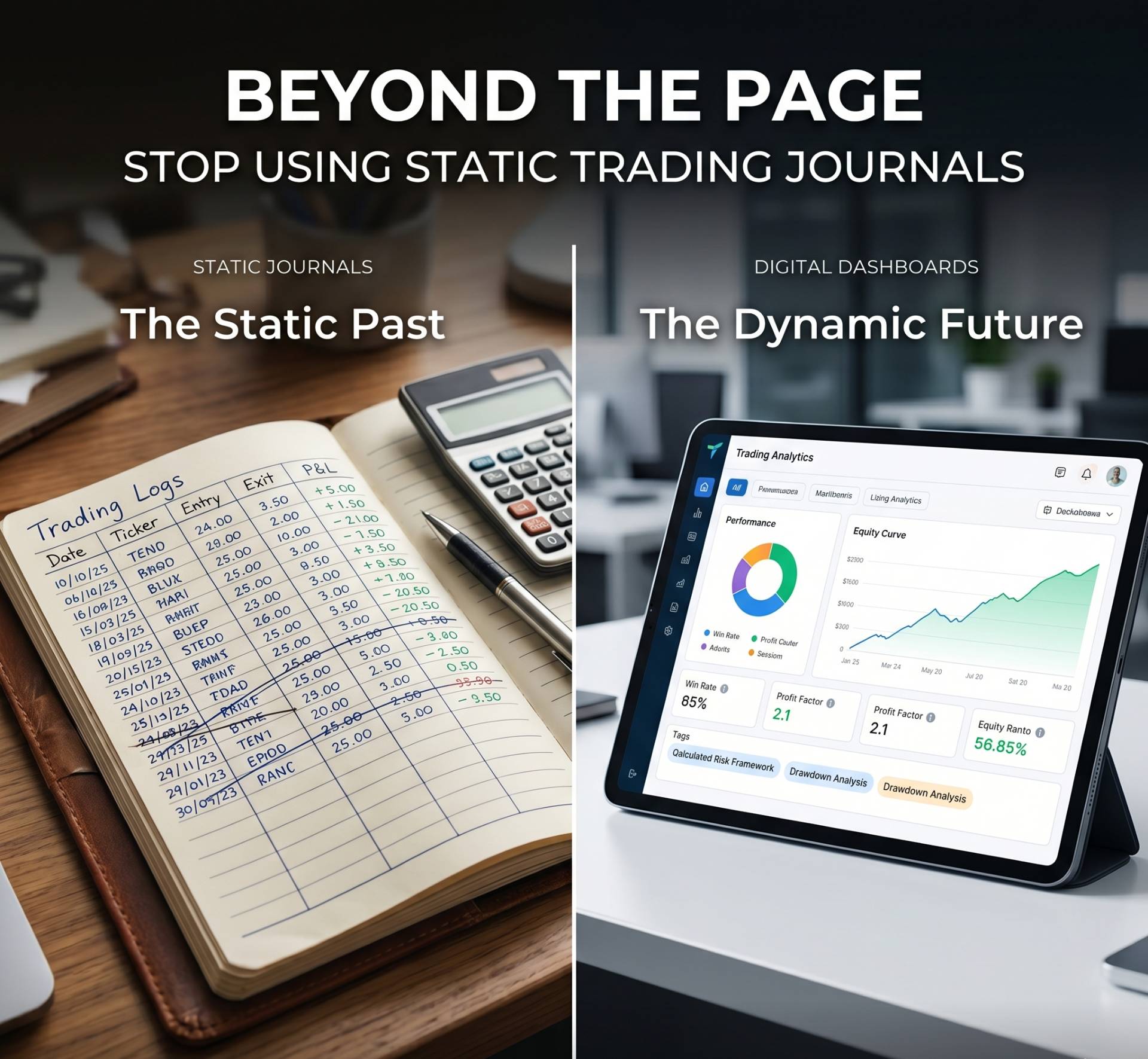
Table of Contents
Scanning sections...
Every day, struggling traders go online to search for a trading journal pdf or a pre-formatted template to print out. They buy a premium leather notebook or download a trading journal book pdf, thinking that the physical act of writing down trades will magically instill discipline into their execution. They copy down the date, the ticker, the entry price, and the final profit or loss figure into a rigid layout.
This approach fails because it treats trading like a high school diary instead of a high-performance business.
A static layout is entirely non-reactive. The markets are dynamic, shifting through structural regimes, volatile liquidity spikes, and expanding spreads in a matter of seconds. Recording your historical numbers on a frozen grid does nothing to protect your account equity when a sudden drawdown occurs. If your goal is professional capital preservation, a manual paper format is a direct structural bottleneck to your growth.
The Structural Limit of a Static Trading Journal Format
The core failure of any manual trading journal format is that text on a static page cannot scale, aggregate, or cross-reference data. When you fill out rows by hand, you are capturing isolated snapshots of individual outcomes. You are not building a cohesive statistical model of your trading behavior.
Consider what happens when you attempt to answer critical performance questions using a manual book or PDF:
- What is your mathematical expectancy across different sessions?
- How does your win rate degrade when you hold options contracts past 2:00 PM?
- What is the compounding capital cost of your top two behavioral mistakes?
To extract these insights from a paper log, you would have to spend hours manually calculating percentages, sorting data by hand, and rebuilding charts on a separate calculator. Because this review process requires immense friction, most retail traders simply skip it. They look at their total P&L at the bottom of the page, feel emotional about the final number, and close the book without diagnosing the underlying leakage.
Why Paper Frameworks Fail Under Sudden Volatility
When you are executing fast-paced intraday setups via modern platforms like MT5 or handling derivative execution through Upstox, speed and data precision are your only real protections. A static printout or a handwritten page acts as a massive lag on your performance review loop for multiple reasons.
Hard Reality Check: Manual Formats vs. Dynamic Systems

When a fast-moving market hits your stop-loss on Upstox or triggers a sudden stop-out on MT5, your manual ledger logs it as a standard loss. It completely fails to track execution slippage—the hidden cost of entering or exiting illiquid contracts during momentum spikes. Over a 100-trade sample, unrecognized slippage can quietly drain thousands from your account balance without ever showing up in your paper calculations.
Upgrading to a Calculated Risk Framework
To move past the amateur level, you must outsource the tedious task of data logging to automated software and focus your cognitive energy strictly on analysis. Your trading terminal already captures the absolute mathematical truth of your execution. Your tracking system must ingest that data instantly without requiring you to type a single cell or pick up a pen.
By transitioning from a printed document to a dynamic cloud infrastructure, you turn a passive accounting ledger into a proactive risk shield. Instead of simply recording what you lost, your system immediately analyzes how and why your capital was compromised.
It calculates your historical maximum drawdown probabilities, monitors your correlation parameters across highly volatile hours, and visually cross-references your execution timestamps directly with your chart snapshots. This transforms your weekend routine from an unorganized autopsy of your losses into an objective, data-driven optimization strategy.
Close the Book on Outdated Tracking
The belief that a beautifully designed paper template or a free printed sheet is enough to survive modern electronic markets is a costly mistake. Professional trading requires professional architecture.
Stop treating your trade tracking like an administrative chore or a casual evening journal. Ditch the static templates, break free from manual page limits, and transition your execution logs into a rigorous, automated analytics dashboard. Let the amateurs keep diaries—you need to build a statistical edge.