How to Keep a Trading Journal: Stop Tracking P&L and Start Tracking Execution
Most retail traders use their journal as an accounting ledger to track profits and losses. Professional traders use it as a database of their psychological mistakes. Here is exactly what you need to track to build a profitable edge.
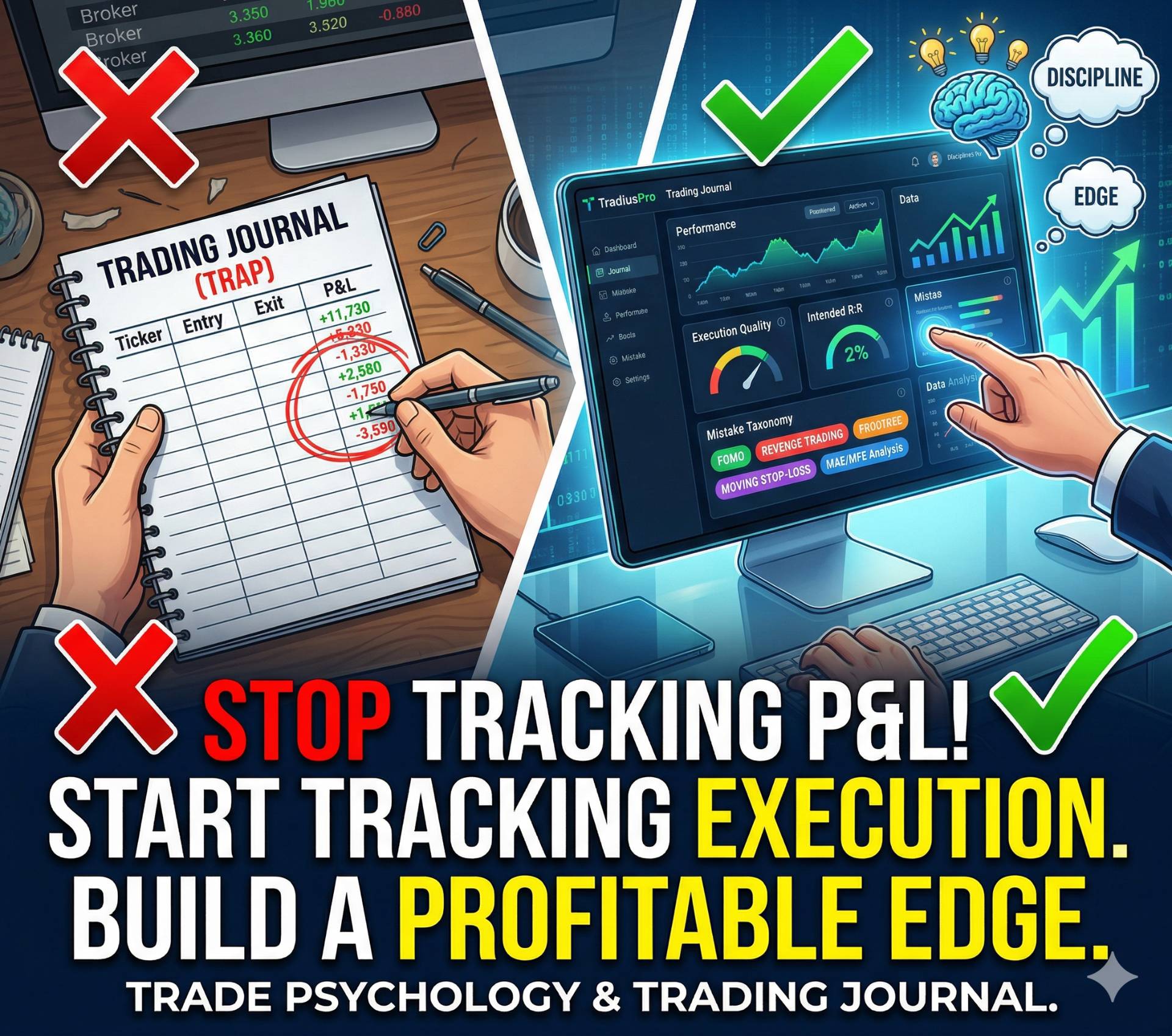
Table of Contents
Scanning sections...
The Accounting Trap: Why Your Current Journal is Useless
If your current trading journal only tracks your ticker symbol, entry price, exit price, and net P&L, you are wasting your time. Your broker already provides this information. Logging your trades is pointless if you never review them to find the patterns that are costing you money.
An effective online trading journal is not an accounting tool; it is a behavioral mirror. Its sole purpose is to expose the gap between your technical analysis and your actual execution. You might have world-class technical skills, but if you execute based on fear or greed, your account will bleed.
Here is exactly how to keep a trading journal that actually improves your profitability.
What to Track in a Trading Journal
To fix your trading, you must stop focusing on the outcome and start focusing on the intent and the execution. Here are the mandatory metrics you must track:
1. Intended Risk/Reward vs. Actual Risk/Reward Before you click buy or sell, you must know your exact stop-loss and target. You must log your intended stop loss and target price before the trade plays out. This establishes your intended Risk/Reward (R:R) ratio. By comparing your intended R:R to your actual R:R, you can instantly see if you are choking on your exits by taking profits too early or letting losers run past your stop loss.
2. The Execution Mistake Taxonomy You need to identify exactly why you lost money. Create a strict, unchangeable list of behavioral mistake tags and assign them to your losing trades. The most common trading journal mistakes include:
- FOMO (Fear Of Missing Out)
- Revenge Trading
- Moving the Stop-Loss
- Trading outside of the plan
When you tag your mistakes consistently, the data will reveal the brutal truth. You will likely find that 80% of your losses come from just one or two bad habits.
3. MAE and MFE (The Truth About Your Entries and Exits) Advanced traders track Maximum Adverse Excursion (MAE) and Maximum Favorable Excursion (MFE).
- MFE tells you how much profit was available in the trade before you exited. If your MFE is consistently high but your realized profits are low, your psychology is flawed, and you are exiting out of fear.
- MAE tells you how far the trade went against you. If your MAE is constantly hitting your stop-loss, your technical entries are premature.
4. The Visual Chart Log Numbers only tell half the story. You must attach a screenshot of your chart at the moment of entry to every single trade. When you look at 20 losing screenshots side-by-side, visual patterns emerge instantly. You will quickly identify which setups are garbage and which ones constitute your true "A+" edge.
Stop Guessing. Automate Your Edge.
If you try to track all of these variables in a manual spreadsheet, you will eventually quit. The friction of manual data entry is why most traders fail to maintain the habit.
This is why serious traders worldwide rely on TradiusPro. It is an automated trading journal that imports your data, calculates your MAE/MFE, visualizes your R:R, and forces you to confront your behavioral mistakes.
Stop treating your journal like a diary. Make it a database. Start your free trial with TradiusPro today and discover the data-driven edge you've been missing.