The Anatomy of a Tilt: Why a Paper Log Can't Stop Revenge Trading
Writing down your losses in a notebook will not stop you from self-destructing after a bad trade. Learn why tracking emotional triggers requires dynamic software, not ink and paper, to prevent catastrophic revenge trading.
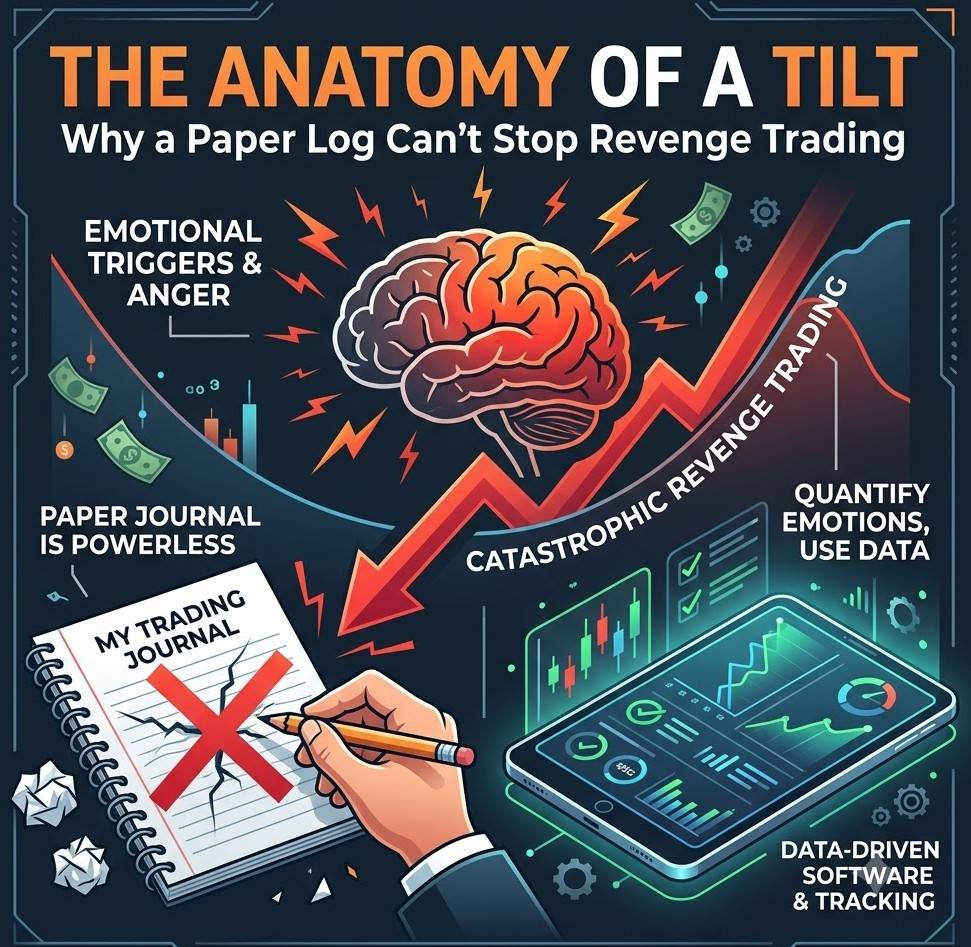
Table of Contents
Scanning sections...
The Romantic Delusion of the Handwritten Ledger
There is a persistent myth in the retail trading community that keeping a paper trading journal will make you a more disciplined trader. Traders buy expensive, leather-bound notebooks, believing that the physical act of writing down a trade will slow their mind down and forge a deeper connection to the market.
Let us look at the brutal reality. When you are actively trading volatile global indices or Gold (XAUUSD), the market does not care about your penmanship. When a sudden wick stops you out by a single point before reversing straight to your target, your logical brain shuts down. The limbic system takes over, and the "tilt" begins.
In that moment of pure anger, a handwritten trading journal sitting on your desk is completely powerless. It cannot mathematically intervene. It cannot lock your screen. It simply sits there while you aggressively switch back to your terminal to double your position size and "win back" the capital the market just stole from you.
Why Emotional Tracking Requires Data, Not Diaries
Mastering trading psychology is not about pretending you do not feel fear or anger. It is about operating strictly within probabilities and tracking the exact numerical cost of your emotional deviations.
A physical notebook forces you to write subjective paragraphs about how you felt. "I felt anxious and entered early." This is qualitative fluff. It tells you nothing about the mathematical destruction that anxiety caused to your equity curve over the last 90 days.
To systematically eliminate psychological leakage, you must quantify your behavior. A dedicated trading journal app converts your subjective emotions into hard data points.
- Instead of writing a paragraph about your frustration, you simply tag the execution as "Revenge Trade" or "FOMO."
- The software aggregates those tags against your raw execution data.
- By the end of the month, the analytics dashboard shows you the unvarnished truth: your "FOMO" habit on Tuesday mornings has a negative expectancy of ₹15,000.
Seeing the exact financial cost of your lack of discipline is the only shock therapy that actually stops bad habits.
The Execution Gap: Lag Kills Discipline
If you are executing rapid intraday setups through brokers like Zerodha or routing orders via Nuvama, speed is your primary execution edge. The delay between clicking "buy" and manually writing down your entry parameters is where psychological discipline goes to die.

When you are spiraling into a drawdown, you will inevitably stop writing in your physical book out of shame. The pain of manually logging your failure guarantees that you will abandon the journal entirely. By automating the data ingestion directly from Nuvama or Zerodha, you remove the choice. The data is logged automatically. You are forced to confront the reality of your execution, stripping away all excuses.
Outsource Your Discipline to the Machine
You cannot rely on your own willpower to stop a revenge trading spiral. Willpower is a finite resource that vanishes completely the moment you take an unexpected loss.
Stop treating your trading psychology like a high school journaling exercise. You are running a quantitative business. Ditch the paper trading journal and transition to a ruthless, data-driven framework. Tag your mistakes, let the software calculate the mathematical damage of your emotions, and execute your edge like a machine.