The Best Trading Journal in 2026: Why Serious Traders Are Ditching Spreadsheets
Still tracking trades in Excel? Discover why the best trading journal software in 2026 is purpose-built, not patched together — and what separates serious traders from the rest.
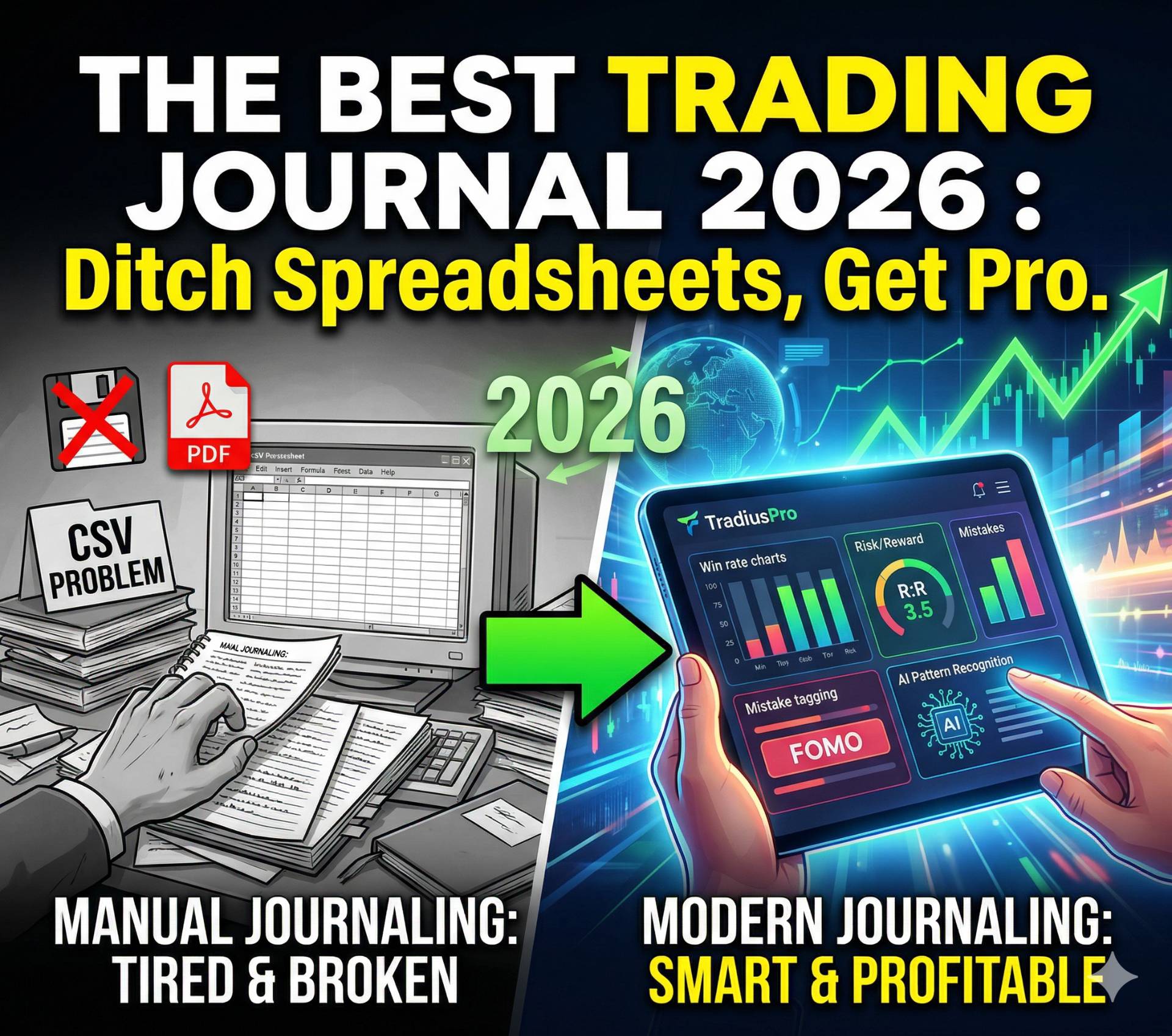
Table of Contents
Scanning sections...
The Best Trading Journal in 2026: Why Serious Traders Are Ditching Spreadsheets
Ask any consistently profitable trader what their most important tool is. They won't say their broker. They won't say their charting platform. Almost every single one of them will say the same thing: their trading journal.
But not all trading journals are created equal. In 2026, the gap between traders who use a spreadsheet and traders who use a purpose-built journal has never been wider — and it's showing up directly in their P&L.
This guide breaks down what the best trading journal actually looks like, what features matter, and why the traders who are serious about profitability have moved far beyond manual tracking.
Why Your Excel Spreadsheet Is Quietly Costing You Money
Many beginners start by downloading a free trading journal pdf or a printable trading journal template. Eventually, they upgrade to Excel. Excel is a brilliant tool—built for accountants and financial analysts. It was never designed to be a trading journal.
When you use a spreadsheet or a static template, you are manually entering every trade, calculating your win rate, building your P&L formula, and trying to cross-reference your chart screenshots with your trade data. This process isn't just tedious — it's broken.
Here's what happens in practice: You take 30 trades in a week. By Friday, you've entered maybe 20 of them. By the time the weekend arrives, reviewing those trades feels like a chore, so you skip it. And this is exactly the feedback loop that keeps traders stuck. The review is not optional — it's the entire point of journaling in the first place.
The best trading journal eliminates this friction completely. It imports your trades automatically, tags your mistakes, and surfaces the data you need without you having to do the analytical heavy lifting.
What Makes a Trading Journal the "Best" in 2026?
The market for trading journal software has expanded significantly. You have options like Tradezella, TradesViz, TraderSync, and StonkJournal. So what actually separates a good tool from the best one?
Here are the non-negotiable features that define elite trading journal software:
1. Automatic Trade Import via CSV
Manually entering trades is not a journal — it's data entry. The best platforms import your complete trade history directly from your broker. TradiusPro supports this natively, letting you go from broker export to full analytics in under two minutes.
2. Mistake Tagging and Pattern Recognition
One of the most valuable features of a professional trading journal is the ability to tag why a trade went wrong, not just that it went wrong. The best platforms use trading journal ai and automated pattern recognition to highlight your blind spots. When tags like FOMO, Revenge Trading, or Poor Risk Management accumulate over weeks, the patterns become unmistakable. You'll see that 80% of your losses come from 20% of your bad habits.
3. Risk/Reward Analytics
A serious trading journal doesn't just tell you your win rate. It shows you your average R:R ratio, your Profit Factor, your Maximum Adverse Excursion (MAE), and your Maximum Favorable Excursion (MFE). Knowing your actual R:R distribution is what separates a disciplined trader from a gambler with a good streak.
4. Visual Trade Log with Chart Screenshots
Numbers tell you what happened. Screenshots tell you why. The best trading journals allow you to attach your chart screenshots to each trade entry. After 20-30 trades, an image gallery review reveals your losing setup patterns in a way that no spreadsheet ever could.
5. Performance Segmentation & Mobile Accessibility
Your journal should answer questions like: "Do I make money on Mondays?", or "Am I profitable only with one specific setup?" Furthermore, you need software that works seamlessly on your desktop and functions efficiently as a trading journal app when you are away from your main screens. If your current tool can't answer these questions with a single click anywhere you go, it isn't the best trading journal — it's just a log.
Solving the Data Problem: Why Standard Broker Imports Fail
Traders face a unique challenge that most international trading journal software platforms haven't solved: complex broker data formats.
For example, the two most popular brokers in India — Zerodha and Dhan — produce trade reports in highly specific CSV formats that many mainstream journal tools simply cannot process correctly. This leaves users with the worst of both worlds: expensive software that doesn't understand their data, or a local Excel workaround that doesn't provide real analytics.
TradiusPro is built for global markets, but it completely solves this broker data problem. Whether you trade US equities, forex, Nifty options, or Bank Nifty futures, your tradebook (including complex Zerodha or Dhan exports) imports cleanly and maps to every analytics field correctly.
The "Best" Journal Is the One You Review Every Week
Here's a truth that no software company wants to tell you: the tool matters far less than the habit.
The most profitable traders in the world don't have magic setups. They have systematic, boring, consistent review processes. They look at their data every single weekend. They identify one mistake, create one rule to fix it, and implement it the following week. This compound loop — trade, log, review, adjust — is the actual edge.
The best trading journal simply makes this process frictionless enough that you actually do it. It removes the barriers between you and your data, so the review session takes 20 minutes instead of 3 hours in an Excel nightmare.
Stop guessing. Stop overcomplicating your charts. The data already exists in your broker account — it just needs a home. Start your free TradiusPro account today and import your first tradebook in under 2 minutes.
Frequently Asked Questions (FAQ)
What is a journal in trading?
A trading journal is a detailed log where a trader records their daily trades, including entry and exit points, position size, risk-to-reward ratio, and the emotional or technical reasons behind taking the trade. It is used to analyze past performance and identify mistakes.
What is the best trade journal?
The best trade journal is purpose-built software that automatically imports broker data, tags behavioral mistakes, tracks advanced metrics like MAE and MFE, and allows for visual chart storage. Platforms like TradiusPro are widely considered superior to manual spreadsheets because they eliminate data entry friction.
Is it true that 97% of day traders lose money?
Yes, various academic and brokerage studies suggest that the vast majority of day traders fail to make a consistent profit over time. A primary reason for this failure rate is a lack of strict risk management and the absence of a systematic journaling and review process.